7. 2. – 7. 6. 2026
Opening Friday, Feb 6, 2026, from 6 PM
From February 7 to June 7, 2026, Marta Herford becomes the site of unusual and ongoing processes. The dual exhibition devoted to Lois Weinberger (1947–2020) and Katinka Bock (born 1976) brings into view, in poetic form, phenomena beyond human control: materials react, spaces shift, and natural forces leave their traces—inside the museum as well as beyond its walls. An extensive public program accompanies the exhibition, featuring film screenings, artist talks, and workshops.
When plants push through asphalt or water follows its own course, processes emerge that unfold beyond human agency. What is usually perceived as a disruption in everyday life moves to the center of artistic attention in this dual exhibition of works by Lois Weinberger and Katinka Bock. Both artistic practices are united by a sensitive, attentive engagement with natural and physical processes—growth, movement, transformation, and trace. A dialogue unfolds between two artists who work in different media to draw seemingly hidden natural processes and physical forces into their art. Poetically, philosophically, and politically, both practices question established hierarchies between culture and nature, as well as between the obvious and the overlooked.
Pioneer of Ecological Art
At the core of Lois Weinberger’s work lies a sustained engagement with plants and the natural environment. His particular attention is directed toward “ruderal” plants—species commonly dismissed as weeds. Weinberger not only makes them the subject of his observations and artworks; he also grants them space as active protagonists within his practice. His contribution to documenta X (1997), Das über Pflanzen ist eins mit ihnen (“What Is Above Plants Is One with Them”), has achieved iconic status. For this work, a disused railway track was allowed to become overgrown with neophytes—non-native plants that spread through processes of migration.
Portable Garden (1996/2026), previously shown in various locations, is installed as part of the exhibition on Goebenstrasse in front of the museum. Checkered plastic bags filled with agricultural soil are distributed across the site, allowing spontaneous vegetation to develop over the course of the exhibition. This growth emerges from seeds already present in the soil as well as those carried by the wind. Weinberger referred to this constellation as a ruderal society. The choice of container is deliberate: known as “migrant bags,” they point to the inseparable entanglement of ecological mixing, the spread of plant species, and the migration of people and cultures.
The large-scale wall drawing Wege (“Paths”, 2005/2026), realized in the Marta Dome, further sharpens our awareness of natural processes and creative forces at work. Weinberger translated the feeding tunnels of bark beetles into a red drawing, greatly enlarged and deliberately painted “carelessly” on the curved interior wall of the building designed by Frank Gehry. The traces of a natural process become an emblem of hidden systems of passage. Authorship here is shared by humans and animals in an act of collaboration.
The relationship between humans, nature, and the environment also recurs throughout Weinberger’s poetic text works, which take the form of poems or inscriptions on topographical map drawings (Field Works).
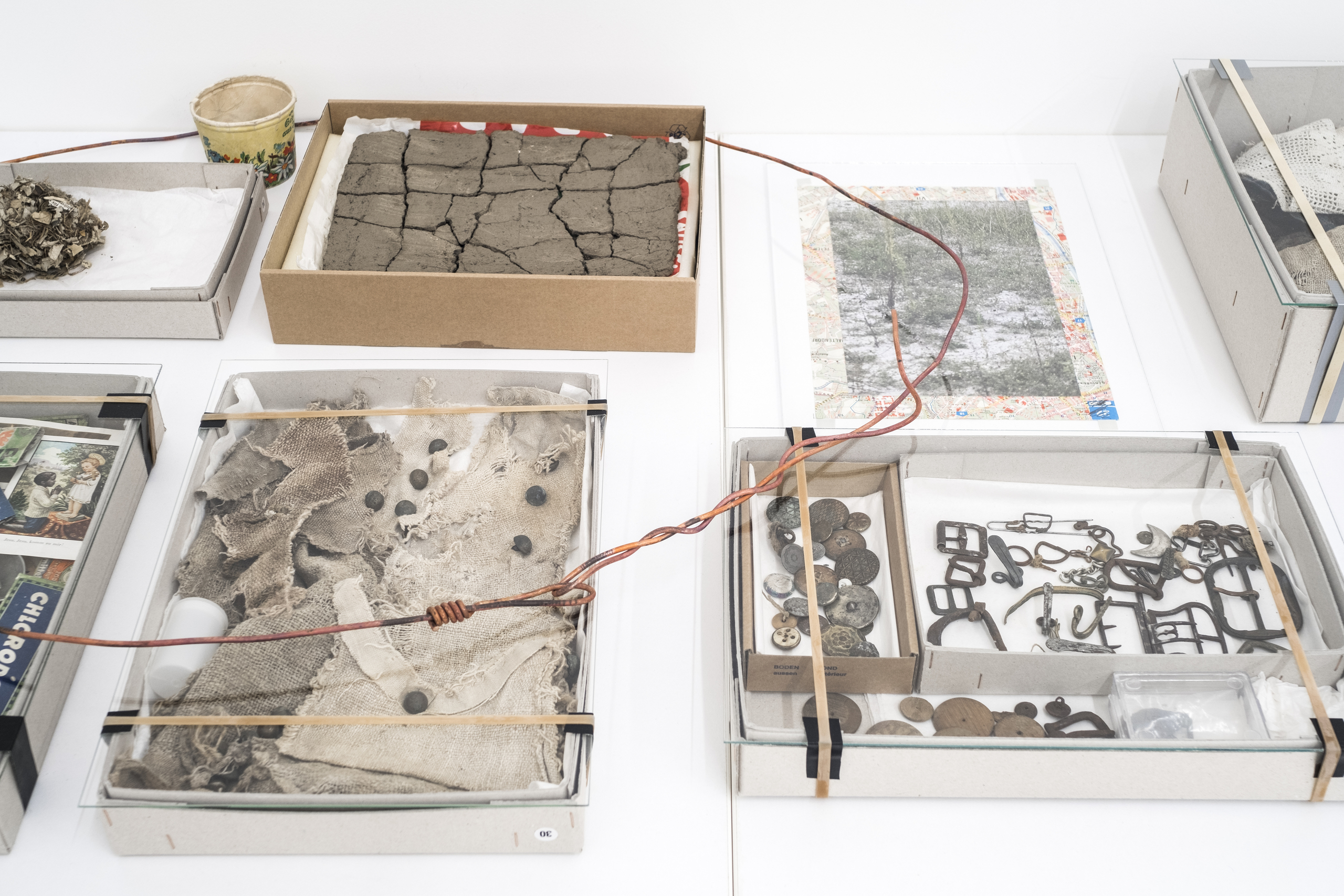
Debris Field (2010–16) comprises a collection of objects gathered by Weinberger in and around his parents’ farmhouse in Stams, Tyrol, and first exhibited in 2017 at documenta 14 in Athens as an artistically curated archaeological archive. Around 1,000 found objects—tools, clothing, documents, household items, religious artifacts, mummified animal remains, along with notes and drawings by the artist—record the traces of an unwritten local history spanning the 14th to the 20th century. The work opens up an anthropological and, at the same time, aesthetic perspective.
The spatially responsive staging of Weinberger’s works has been developed in close collaboration with Franziska Weinberger. An art historian and the artist’s widow, she worked closely with him on numerous projects and is responsible for the reinstallation of his works for this exhibition in accordance with his intentions.
Beyond the works on view, the documentary Lois Weinberger—Ruderal Society (directed by Markus Heltschl), which premiered at the Viennale in Vienna in 2025, offers further insight into the artist’s practice. Excerpts are presented in the exhibition, and the full-length film (96 minutes, English with German subtitles) will be screened several times during the exhibition period.
Research into Material and Process
Katinka Bock’s work centers on close attention to material—its properties, its capacity for change, and its relationship to the human body. Her sculptures employ materials of natural or traditional sculptural origin, including copper, ceramic, wood, stone, and bronze. She draws on archaic, artisanal techniques such as bending, winding, and folding, as well as processes of evaporation and oxidation, deliberately allowing chance and material trace to shape the work. Recurrent elements include basic forms—planes, circular segments, rod structures—as well as everyday tools such as spoons, compasses, and needles.
Created especially for the exhibition, the floor work One of Hundred (Segments with Unknown Radius) (2026) was realized in collaboration with members of the museum’s friends and supporters association (Marta Freunde und Förderer e.V.). The work consists of a ring of 100 copper plates of varying dimensions, which were placed over recent months in the homes and gardens of participating individuals to collect traces. Weathering, oxidation, and material reactions form the patina of the finished work, which functions in the exhibition as a form of social sculpture. In this process, the artist consciously relinquished control, involving people connected to the museum. Her sole condition was that the traces not be artificially produced or manipulated.
Another new work establishes a direct relationship with the museum building itself. Population Churchill (2026) is based on research conducted by the artist in Hangzhou, China. The name of the sewing machine brand Churchill is examined; the machine is dismantled; and individual components are cast in bronze and mounted on metal workshop trestles. Alongside her sculptural practice, Bock has long worked with photography, and a new photographic series emerging from this research has been produced for the exhibition.
The sewing machine forms a conceptual link to the architecture of Marta Herford, where Frank Gehry’s building incorporates a former textile factory. This connection is extended spatially: a copper pipe, visibly connected to the building’s water system and thus to the central infrastructure, drips water rhythmically into the sculptural ensemble. Rhythm, time, and ultimately history become operative forces, engaging multiple senses and gradually inscribing new traces into the building itself.
Cartographies of Growth – An Exhibition in Transition
In their respective practices, Lois Weinberger and Katinka Bock develop poetic forms of expression that describe, explore, and question the relationship between nature, material, and the human. They make space for chance and for collaboration—both human and nonhuman. Traces, observations, and the passage of time are recorded in abstract cartographies. While ecological approaches on the one hand and technical and chemical processes on the other play a significant role, the works also open up an intense sensory experience.
Both artistic practices enter into direct dialogue with the building and its exterior spaces. Growth and transformation are consciously permitted: water spreads through interior spaces, while plants continue to grow outside. In this way, museum conventions are questioned and reconfigured. Over the course of the exhibition, the museum is permeated by natural processes, while the exhibition itself extends into the surrounding urban space.
With the kind support of
Kunststiftung NRW, Österreichisches Bundesministerium Wohnen, Kunst, Kultur, Medien und Sport, Institut Français, République Française
